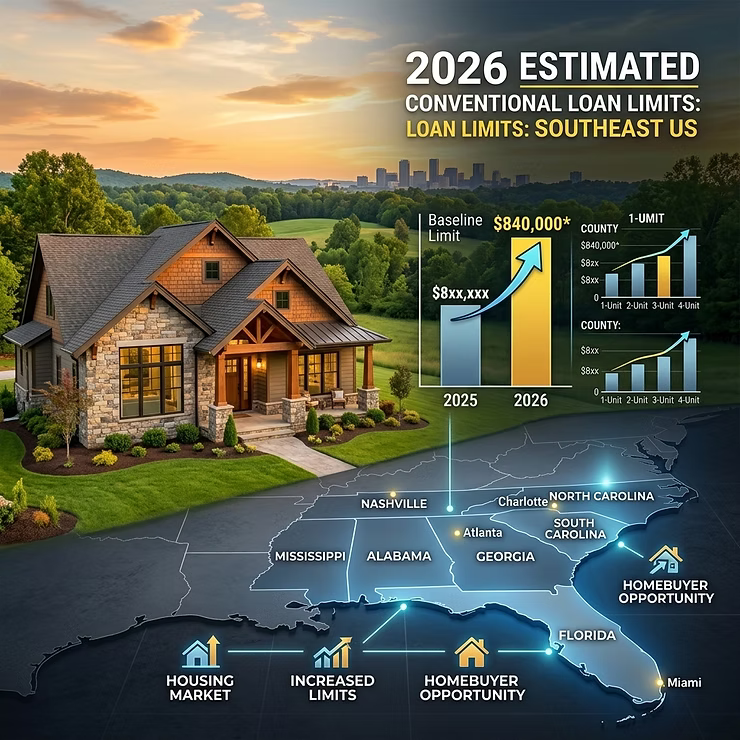
As we move through the 2026 housing market, a critical shift has occurred for anyone looking to purchase or refinance a home. The Federal Housing Finance Agency (FHFA) has officially adjusted the baseline figures for conforming mortgages, significantly impacting the Conventional Loan Limits 2026 Southeast buyers can utilize. For many, this change represents a substantial boost in purchasing power, moving homes that previously required complex jumbo financing into the more accessible world of conventional lending. Whether you are navigating the competitive suburban markets of North Carolina or the high-demand corridors of Texas, understanding these new limits is the first step toward securing a favorable mortgage.
What Changed
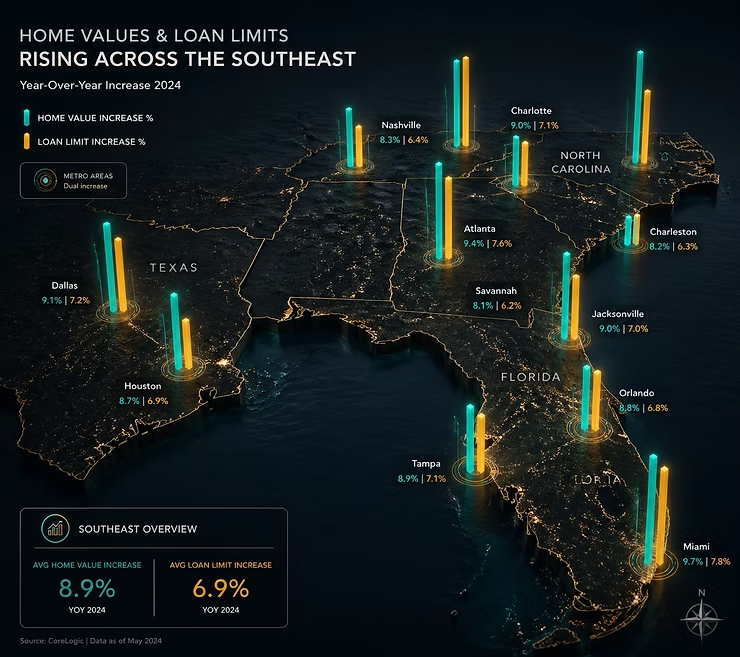
The FHFA recently announced that the baseline conforming loan limit for 2026 has increased to $832,750 for single-family properties. This marks a roughly 3.26% increase over the previous year’s limits. These adjustments aren’t arbitrary; they are calculated annually based on the FHFA’s House Price Index, which tracks the average change in home values across the United States.
In the Southeast, where high-growth metros have seen steady appreciation, this increase is particularly relevant. While the $832,750 figure is the “baseline” used in most counties, certain high-cost areas, where local median home values significantly exceed the national average, feature even higher ceilings. In these designated high-cost zones, the limit can scale up to $1,249,125 for a one-unit property.
The logic behind the increase is simple: as home prices rise, the “ceiling” for standard loans must rise with them. Without these adjustments, homebuyers would be forced into jumbo loan territory more often, which often requires higher down payments and more stringent credit requirements.
Why It Matters
For the average homebuyer or Realtor in the Southeast, these numbers represent more than just a data point, they represent a financial strategy. The distinction between a “conforming” loan and a “jumbo” loan is substantial.
-
Lower Interest Rates: Historically, conforming loans (those that fall under the 2026 conventional loan limits) offer more competitive interest rates than jumbo loans. By staying within these limits, borrowers can often save thousands of dollars over the life of the loan.
-
Flexible Down Payment Options: Conforming loans allow for down payments as low as 3% for qualified first-time buyers and 5% for many others. Conversely, jumbo loans often require 10%, 15%, or even 20% down, which can be a significant barrier for buyers in markets like Austin, TX, or Nashville, TN.
-
Easier Qualification: Conforming loans follow the standardized underwriting guidelines set by Fannie Mae and Freddie Mac. Jumbo loans are typically held on a bank’s own books, meaning they can have much stricter requirements regarding cash reserves, debt-to-income ratios, and credit scores.
-
Buying Power Boost: If you were looking at a home priced at $850,000 last year, you might have been forced into a jumbo loan if you didn’t have a large down payment. With the 2026 baseline limit now at $832,750, that same home likely fits into a conventional loan structure today.
Example Scenario: The High-Growth Transition
To see how the Fannie Mae loan limits NC TX VA buyers are seeing play out in real time, consider a buyer named Marcus in Charlotte, North Carolina.
In late 2025, Marcus found a home for $845,000. At the time, the loan limit was lower, meaning that even with a 5% down payment ($42,250), his loan amount would have been roughly $802,750. If that exceeded the local limit at the time, he would have had to either come up with more cash to bring the loan down to the conforming limit or apply for a jumbo loan with a much higher interest rate and a required 15% down payment ($126,750).
With the 2026 limits in place, Marcus can now finance that same $845,000 home with a conventional loan. Because the limit has risen to $832,750, his loan amount fits comfortably within the conforming guidelines. Marcus saves over $80,000 in upfront cash requirements and secures a lower interest rate, making the home much more affordable on a monthly basis.
Similar scenarios are unfolding in markets like Virginia Beach or the outskirts of Austin, where prices have hovered just above the old limits, previously sidelining buyers who didn’t have massive cash reserves.
Tips for Buyers, Realtors, and Investors
Navigating the mortgage limits GA FL TN and other Southeast states require a proactive approach. Here is how different market participants can leverage the 2026 limits:
For Buyers
-
Check Your Specific County: While the baseline is $832,750, several counties in the Southeast are considered high-cost. Always verify the specific limit for the county where you are shopping.
-
Leverage Multi-Unit Limits: If you are looking to “house hack,” notice that the 2-unit limit is over $1 million. You can buy a duplex, live in one side, and rent the other using a conventional loan with a relatively small down payment.
-
Monitor the “Gap”: If the home you want is slightly above the limit, consider if a slightly larger down payment could pull the loan into the conforming range to save on interest rates.
For Realtors
-
Revisit “Dead” Leads: Reach out to clients who were sidelined last year because they couldn’t quite qualify for a jumbo loan or didn’t have the 20% down payment required for higher price points. The new limits may have put them back in the game.
-
Market to Move-Up Buyers: Use the 2026 limits to show current homeowners how much more “house” they can afford without hitting the jumbo threshold.
-
Highlight Financing in Listings: For listings priced between $800,000 and $900,000, explicitly mention that “Conventional Financing is Available” to attract buyers who assume they need a jumbo loan.
For Investors
-
Portfolio Expansion: With higher limits on 2-4 unit properties, investors can use conventional financing to acquire more units with lower interest rates than commercial or hard-money loans.
-
Texas and Florida Growth: In markets like Austin or Miami, the high-cost ceilings provide a massive window for conventional financing in premium neighborhoods.
Bottom Line
The 2026 conventional loan limits are a direct response to the resilient housing market across the Southeast. By raising the baseline to $832,750, the FHFA has effectively expanded the playing field for buyers who want the stability and affordability of a conforming mortgage.
Whether you are looking at a suburban family home in Georgia or a high-rise condo in Florida, these new limits are designed to keep pace with your needs. The key is to act early and understand how your specific county’s limits impact your pre-approval. Staying within the conforming limit is often the difference between a deal that makes sense and one that is out of reach.
