A lower mortgage rate could improve your monthly payment. But waiting for one also means paying rent, watching home prices, and potentially giving up today’s negotiating leverage. There is no single future rate that settles the question. Instead, compare three possible futures: rates fall, stay flat, or rise. Then add the details that belong to your household, not just the market.

What Changed
Freddie Mac’s 30-year fixed-rate mortgage average reached 7.40% for the week ending October 8, 2026, up from 7.28% the week before. Freddie Mac described the latest reading as a high not seen in roughly three years. That is a meaningful change for anyone whose budget depends on a particular monthly payment. Freddie Mac’s weekly survey is a national average, not a quote for a specific borrower.
But rates did not move in just one direction. Mortgage News Daily reported that the average top-tier 30-year rate recorded its largest single-day decline in about three months that same week. The daily index and Freddie Mac’s weekly survey use different methods, but together they show why one day or one week should not be treated as a trend. Rate volatility works both ways. Mortgage News Daily’s rate coverage tracks those daily changes.
Other parts of the housing equation are moving, too:
- In September, Zillow estimated that the typical U.S. monthly mortgage payment was about $1,922 with 20% down, excluding taxes and insurance. That was roughly 6.7% higher than a year earlier, while typical home values were up about 1%.
- Zillow’s typical U.S. rent reached $1,932, up 2.7% year over year, its largest annual gain since April 2025.
- Redfin estimated that sellers outnumbered buyers nationally by 57.9% in August. Seller concessions appeared in 44.7% of sales.
- Realtor.com reported that price cuts reached a four-year high in September, while active inventory moved closer to pre-pandemic levels.
Those figures describe different measures and time periods, not a guarantee of what will happen in a specific neighborhood. They do show that a buyer today may be able to negotiate terms that could be harder to secure if competition picks up. For another view of the range of possible rate environments, see HousingWire’s October analysis of 7%, 8%, and 9% scenarios. These are scenarios to stress-test, not predictions.
Why It Matters
Waiting is not just a bet on mortgage rates. It combines four costs and potential benefits:
- Rent: Every month of waiting has a housing cost. Rent may rise at renewal, and Zillow’s latest national figures show it is not automatically holding steady.
- Price drift: If the home you want costs more later, you may need a larger down payment and loan. If prices fall or stay flat, waiting can look better.
- The refinance option: Buying now may let you refinance later if rates fall and you still qualify. That option has value, but it is neither free nor guaranteed.
- Negotiating leverage: Today’s seller credits, repair concessions, or price flexibility may not be available under different market conditions.
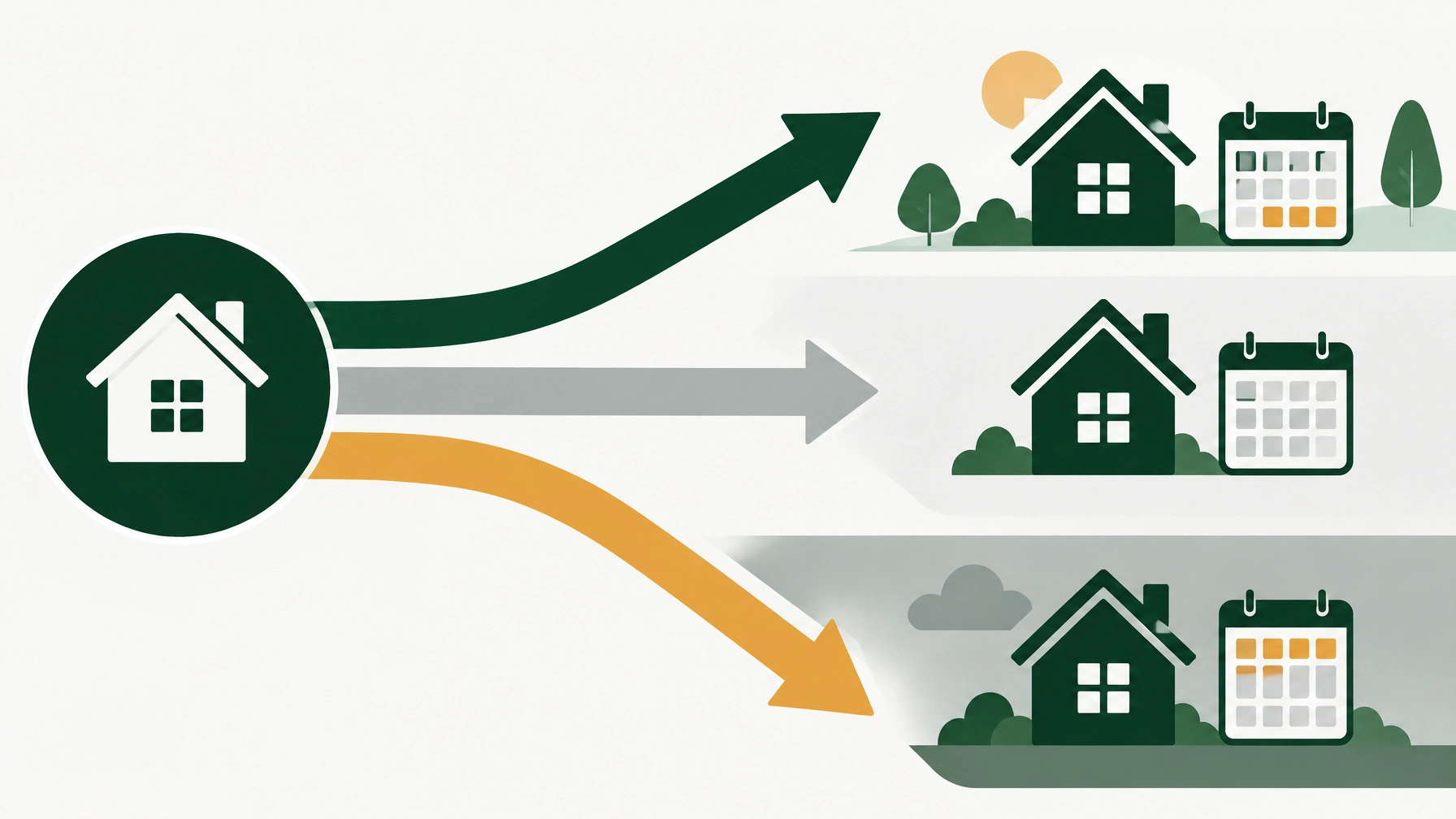
A useful comparison should therefore test three futures, not assume a single rate target. For example, a buyer might model 6.50%, 7.40%, and 8.00% a year from now. Those numbers do not forecast rates. They reveal whether the decision still works across different outcomes.
The sample below uses a $400,000 target home, 10% down, and a $360,000 starting loan. All payment estimates are illustrative principal and interest on a 30-year fixed-rate loan. They exclude taxes, insurance, mortgage insurance, HOA dues, closing costs, maintenance, and any seller credit.
| Scenario | Future rate | Home price change | Future purchase price | Estimated loan | Monthly principal and interest | Estimated 12-month waiting cost |
|---|---|---|---|---|---|---|
| A: Rates fall | 6.50% | +3% | $412,000 | $370,800 | $2,343 | $35,080 |
| B: Rates stay flat | 7.40% | +3% | $412,000 | $370,800 | $2,567 | $35,080 |
| C: Rates rise | 8.00% | 0% | $400,000 | $360,000 | $2,642 | $23,080 |
The arithmetic is straightforward. With 10% down, a $400,000 purchase means a $360,000 loan. At a 3% price increase, the future purchase price is $400,000 × 1.03, or $412,000, and the estimated loan at the same down-payment percentage is $370,800. At 6.50%, principal and interest on that loan is about $2,343 a month; at 7.40%, about $2,567. At 8.00% on a $360,000 loan, it is about $2,642.
The rent estimate assumes $1,900 a month to start, increasing gradually at 2.7% annually, for roughly $23,080 over 12 months. The simple 12-month waiting-cost estimate adds that rent to the full price change: $23,080 + $12,000 in Scenarios A and B, and $23,080 + $0 in Scenario C.
That estimate is a stress-test input, not a complete measure of financial gain or loss. It does not account for the home’s value, principal paid down, transaction costs, or the cost of owning. The payment shown is the payment after waiting, not an extra payment during the year of rent.
The conclusion depends on the full comparison. Scenario A can roughly break even or slightly favor waiting if price drift stays modest and the lower rate is available when the buyer is ready. In Scenario B, waiting adds a year of rent and a higher purchase price without a lower rate. In Scenario C, the buyer could face a higher payment even if prices stay flat. In all three scenarios, waiting means giving up the chance to negotiate today’s seller concessions.
Example Scenario
Elena, a buyer in the Atlanta area, has been waiting since spring for rates to drop. Her target is a $400,000 home, and she has 10% available for the down payment. The numbers below are illustrative, not a client story or a mortgage quote.
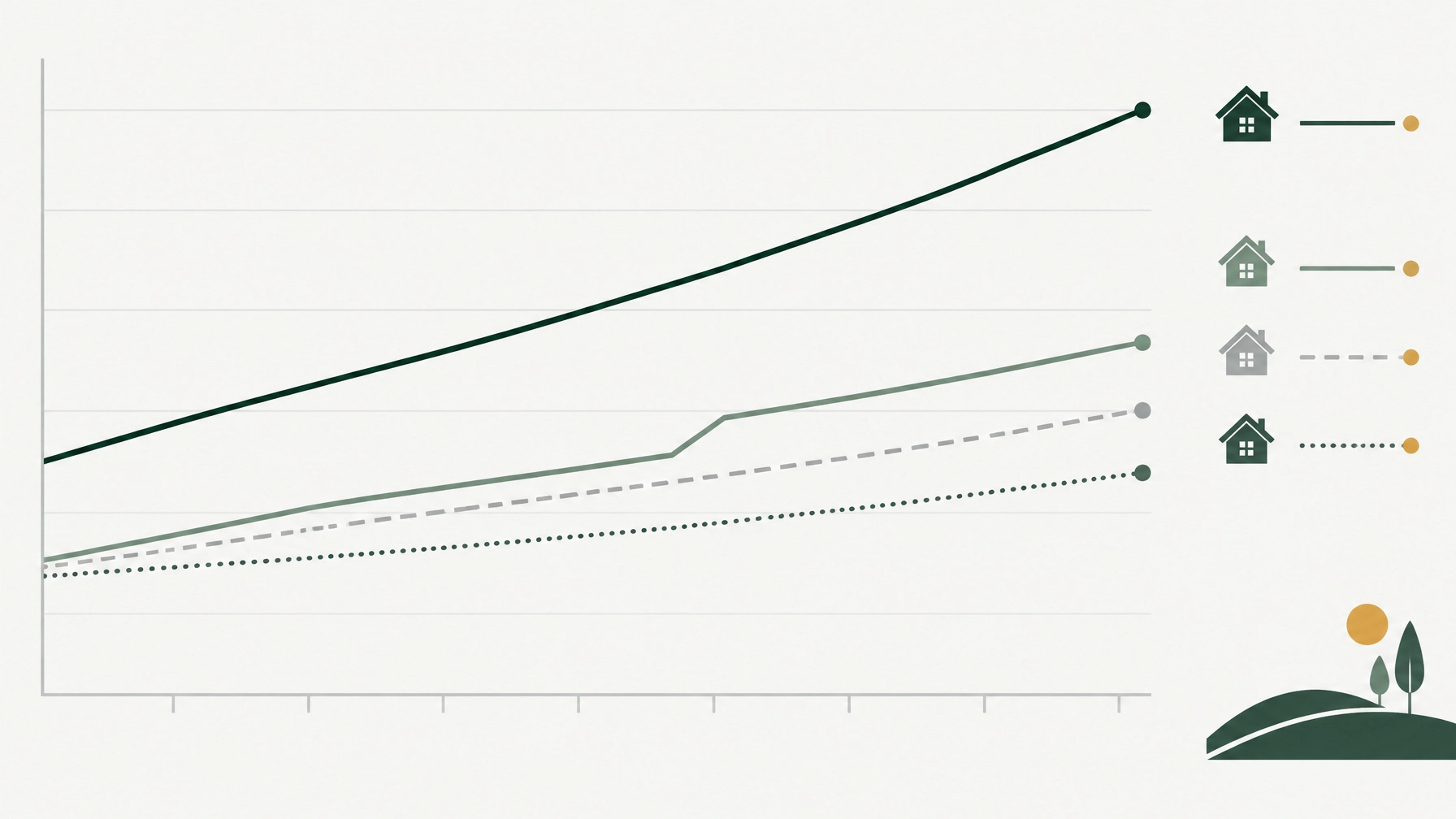
Elena runs the three futures. If rates fall to 6.50% and her target home rises 3%, her estimated future payment is about $2,343 in principal and interest. If rates stay at 7.40%, the payment on the higher-priced home is about $2,567. If rates rise to 8.00% while prices stay flat, it is about $2,642.
The lower-rate future looks appealing, but Elena does not decide based on that one outcome. She checks whether a $2,567 or $2,642 principal-and-interest payment would exceed her comfort limit. She also asks what seller credit might be available now, and whether the seller could fund a permanent buydown that lowers her rate and payment from the start.
To see why that matters, suppose a seller-funded permanent buydown reduced the rate on Elena’s current $360,000 loan by 0.50 percentage point, from 7.40% to 6.90%. Her estimated principal-and-interest payment would be about $2,370 a month, roughly $123 below the estimated payment at 7.40%. The cost of the buydown would depend on the lender’s pricing and the negotiated credit. It would need to fit program rules and any applicable seller-contribution limits.
This second version changes the question. Elena would be comparing a payment reduced today through a negotiated credit with a payment that might be lower in a year if rates fall. She would not need to assume the future rate change will happen. If the seller’s credit is unavailable, or if her payment is still too high, her decision could change again.

Tips
- Define your hold period first. A buyer planning to stay for several years may view costs differently from someone who may move soon.
- Include rent and price drift. Do not compare only today’s rate with a hypothetical future rate.
- Run three futures. Model lower, flat, and higher rates. Notice the point where your answer flips.
- Ask what a seller-funded permanent buydown does to the payment today. Compare the payment benefit with the credit’s cost and the terms of the offer.
- Treat a refinance as an option, not a plan. Refinancing has closing costs, a timeline, and eligibility requirements. Future rates, equity, credit, income, and other circumstances matter. It is not guaranteed.
- Watch your rent renewal date. It is a real deadline that may affect your next housing cost.
- Set a payment ceiling and stick to it. Compare the full expected housing budget, not a rate headline or a lender’s maximum approval amount.
- Check your household variables. Consider income stability, how likely rent is to increase, and whether you need a specific school area, commute, or home layout that may not be available in a year.
- Keep reserves after closing. Do not use every available dollar to buy a home.
- Do not buy if you are not ready. A buyer who cannot comfortably afford the payment, lacks reserves, or needs more time to prepare should not buy. For that buyer, waiting is not a rate strategy. It is preparation.
To review your payment scenarios and financing options, Talk to the Expert. If you need to organize your budget or documents first, Get Mortgage Ready.
Bottom Line
Do not make waiting a wager on a particular mortgage rate. Compare the bundle: rent, home-price changes, the option to refinance, and the negotiating leverage you may give up.
Build three hypothetical futures and test them against your payment ceiling, savings, income, and timeline. If a small change in one assumption flips your answer, the decision is not robust yet. Refine the numbers before you commit.
A purchase should work on the terms available, not depend on a future rate change to become affordable. If you are not financially ready, use the time to prepare. If you are ready, compare a purchase now, a negotiated seller credit, and a wait scenario with the same care.
