Adjustable-rate mortgages are back in the conversation.
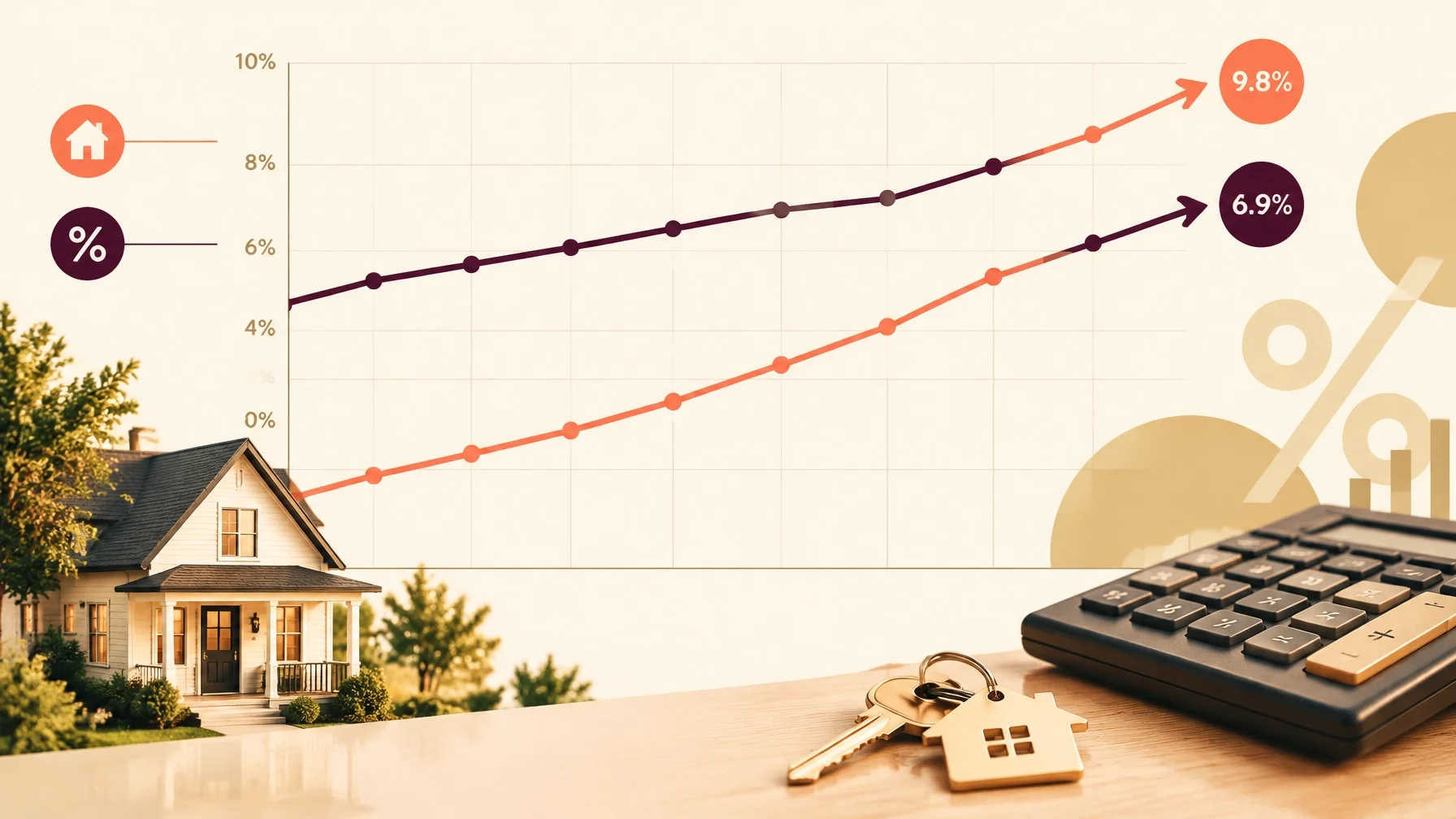
According to the Mortgage Bankers Association’s Weekly Mortgage Applications Survey, ARMs represented 9.8% of total mortgage applications for the week ending September 18, 2026, up from 8.4% the week before.
That shift makes sense. The Freddie Mac Primary Mortgage Market Survey reported that the average 30-year fixed mortgage rate reached 7.03% for the week ending September 24, 2026. It was the fifth consecutive weekly increase and the first reading above 7% since early 2025. Daily market observations have recently reached roughly 7.24%.
A 7/6 ARM recently priced in the mid-6% range, approximately 40 to 75 basis points below comparable fixed-rate financing. That difference can produce meaningful savings, especially on a larger loan.
But an ARM is not simply a cheaper 30-year mortgage. It is a timing strategy. The right question is not, “How much lower is the starting payment?” Ask instead: Will the loan still fit if you own the home when the payment begins to adjust?
Use the worksheet below to compare the introductory payment with a fixed alternative and a potential first reset.
What Changed
An ARM has several moving parts that a fixed-rate mortgage does not.
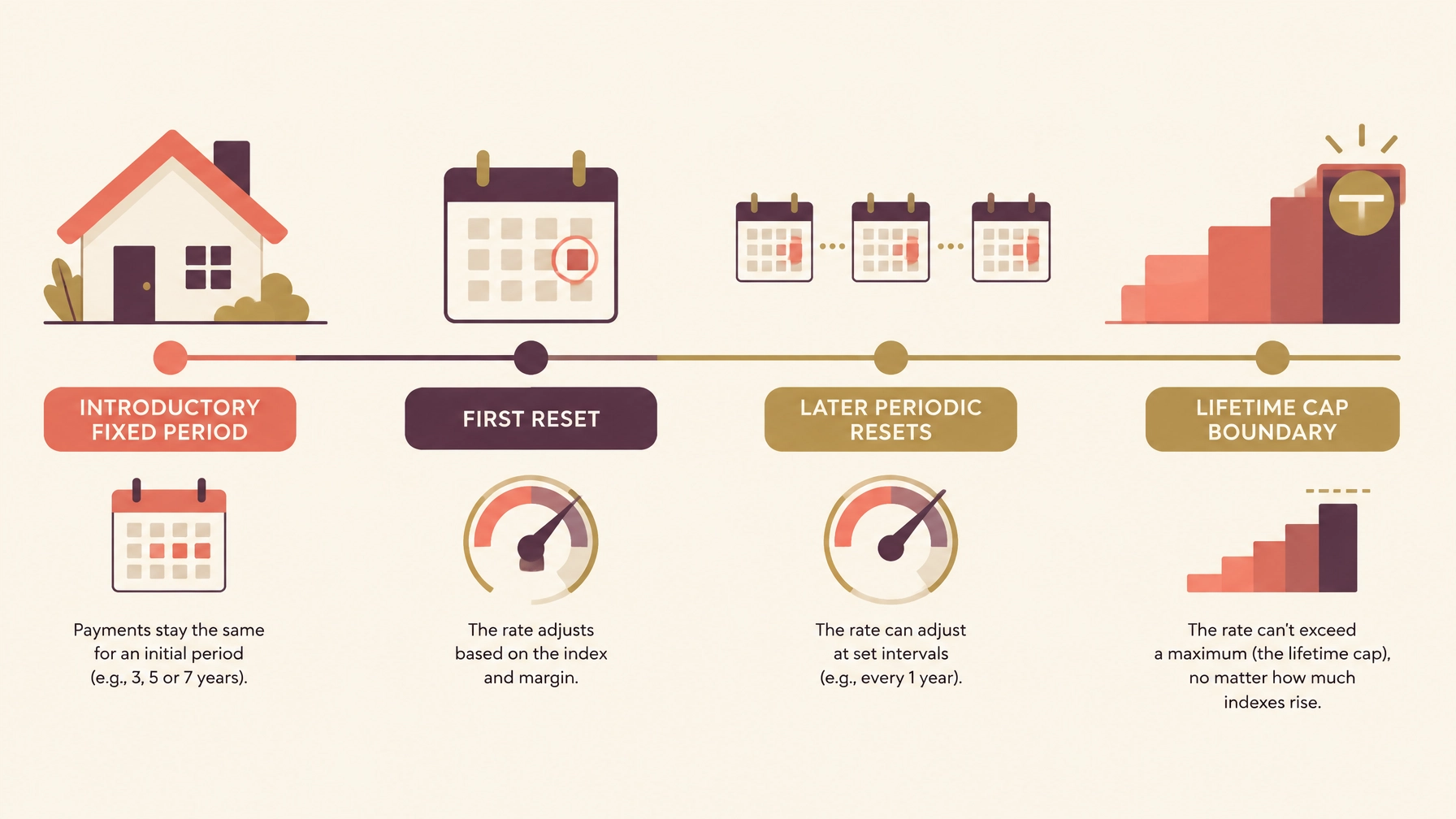
A hybrid ARM begins with a fixed introductory period. Common structures include:
- 5/6 ARM: Fixed for five years, then adjusts every six months.
- 7/6 ARM: Fixed for seven years, then adjusts every six months.
- 10/1 ARM: Fixed for 10 years, then adjusts annually.
After the introductory period, the interest rate is generally based on an index plus a stated margin. Many current loans use a secured overnight financing rate, or SOFR, index. The margin is the lender’s contractual spread over that index.
The loan also includes caps that limit how quickly the rate can change:
- Initial adjustment cap: Limits the first increase.
- Periodic adjustment cap: Limits later increases.
- Lifetime cap: Limits the maximum rate over the life of the loan.
Review those figures before comparing payments. A low introductory rate without a clear cap structure is incomplete information.
The other critical number is the fully indexed rate. This is the index plus the margin, before applying any applicable caps. Buyers generally qualify using the fully indexed rate or another higher qualifying rate required by the loan program, not simply the introductory rate. Exact underwriting treatment can vary, so ask for the qualifying rate in writing.
That means an ARM’s lower starting payment may not create as much additional buying power as expected.
Why It Matters
The payment spread is real, but so is the timing risk.
Suppose a $450,000 loan has an illustrative 7.03% fixed rate and a 6.35% ARM introductory rate. The ARM may save roughly $210 per month in principal and interest at the beginning. That is meaningful cash flow.
However, if the rate resets to a fully indexed 7.15% after seven years, the payment could move close to the original fixed payment. Later adjustments could move it higher or lower depending on the index, subject to the loan’s caps.
This is why the break-even question matters:
> How long must the buyer keep the loan for the ARM savings to justify the future rate risk?
Do not compare an ARM only with a standard fixed loan. Compare it with a fixed loan that uses a permanent buydown funded by a seller credit.
A seller may agree to contribute toward allowable closing costs, including the cost of permanently reducing the fixed mortgage rate. That alternative could produce a smaller initial spread than the ARM while eliminating future adjustment risk.
Illustrative comparison only. Rates are examples, not loan quotes.
Loan Options
- Rate and period
- Qualification basis
- Best-fit buyer
- Primary risk
Illustrative comparison only. Rates are examples, not loan quotes.
| Loan option | Rate structure | Payment basis | Best fit | Tradeoff |
|---|---|---|---|---|
| Fixed rate with permanent buydown | 30-year fixed; illustrative rate reduced from 7.03% to 6.53% | Note rate and payment, subject to program rules | Buyer who values payment certainty or expects a longer hold | Higher upfront cost or limited seller-credit availability |
| 5/6 ARM | Illustrative 6.35% for five years; then adjusts every six months | Generally based on the fully indexed rate or applicable higher underwriting rate | Buyer with a credible short-to-medium-term exit plan | Earlier reset and more frequent payment changes |
| 7/6 ARM | Illustrative 6.35% for seven years; then adjusts every six months | Generally based on the fully indexed rate or applicable higher underwriting rate | Buyer expecting to move or refinance before the first reset | Payment uncertainty after year seven |
If you are comparing options for a client, Get Mortgage Ready by requesting the fully indexed payment, reset schedule, and permanent-buydown alternative in the same loan comparison.
Example Scenario
Tanya is buying in the Raleigh area. Tanya compared a 7/6 ARM with a fixed-rate mortgage. Her loan amount was $450,000, and the illustrative assumptions were:
- 30-year fixed rate: 7.03%
- Fixed loan with seller-funded permanent buydown: 6.53%
- 7/6 ARM introductory rate: 6.35%
- Fully indexed rate at first reset: 7.15%
- Taxes, insurance, and HOA dues excluded
The estimated principal-and-interest payments looked like this:
- Standard fixed loan at 7.03%: approximately $3,002 per month
- Fixed loan after permanent buydown to 6.53%: approximately $2,853 per month
- 7/6 ARM during introductory period: approximately $2,790 per month
The ARM saved about $63 per month compared with the permanently bought-down fixed loan. That was useful, but not decisive.
At the first reset after seven years, the estimated ARM payment rose to approximately $3,004 per month if the fully indexed rate was 7.15%. The exact payment would depend on the remaining balance, the contract terms, and the rate available under the index-plus-margin formula.
Tanya expected to stay in the home for at least eight to 10 years. Once she compared the ARM with the seller-funded permanent buydown, the decision changed. The ARM produced only a modest monthly advantage during the introductory period, but it exposed her to a reset shortly after her expected move timeline. The fixed option cost more at the beginning but gave her a payment she could plan around.
By contrast, a buyer named Marcus, purchasing near Nashville, expected to relocate for work within four years. He had strong reserves, stable income, and no need to qualify at the maximum payment. A 5/6 or 7/6 ARM could reasonably fit his plan because he expected to sell before the first reset and could absorb the loan if that timeline changed.
The difference was not optimism about future rates. It was the strength of the exit plan and the buyer’s ability to handle the risk.

Tips
Use this checklist before recommending or choosing an adjustable-rate mortgage:
- Ask for the fully indexed payment in writing. Do not rely on the introductory payment alone.
- Review the cap structure. Confirm the initial, periodic, and lifetime caps.
- Confirm the index and margin. Ask exactly how the future rate will be calculated.
- Model the payment at the first reset. Use the projected remaining balance, not just the original loan amount.
- Model the worst-case payment. Apply the contractual caps and lifetime maximum to understand the upper boundary.
- Compare the ARM with a permanent fixed-rate buydown. Ask whether a seller credit could reduce the fixed rate instead.
- Check for a conversion feature. Some ARMs may allow conversion to a fixed rate, but availability, timing, fees, and pricing vary.
- Consider how long you will realistically hold the home. Use your likely timeline, not an optimistic refinance assumption.
- Stress-test your reserves. Include repairs, insurance increases, job changes, and other ownership costs.
- Never use an ARM to stretch past a comfortable payment. If the payment only works at the introductory rate, the loan is too aggressive.
- Ask what happens if refinancing is unavailable. A lower future rate is possible, not guaranteed.
- Have the buyer’s agent review the exit plan. A move, sale, or refinance should have realistic timing and backup options.
For a side-by-side review of an ARM, a fixed loan, and a seller-credit buydown, Talk to the Expert.
Bottom Line
ARMs deserve a closer look when fixed rates move above 7%. The MBA’s 9.8% application share shows that more borrowers are considering them, and the introductory payment savings can be meaningful.
But an adjustable-rate mortgage is not automatically the better deal.
Choose an ARM when the buyer has a short or clearly defined holding period, strong reserves, reliable income, and a payment that remains comfortable after a reset. Be cautious when the buyer is stretching to qualify, plans to hold the home long term, or would struggle with a significant payment increase.
Compare the ARM with a fixed loan that uses a permanent seller-funded buydown. Then evaluate the first reset, worst-case reset, break-even point, and realistic holding period.
The best mortgage is not the one with the lowest payment on day one. It is the one that still works when the buyer’s plan takes longer than expected.
